
How Prep Table Refrigeration Keeps Ingredients Food Safe
A prep table is the hardest working piece of refrigeration in most East Texas kitchens, and it carries more food safety responsibility than any other box on the line. Lettuce, sliced tomatoes, cooked chicken, cheese, and cut melon all sit in shallow pans within arm’s reach of a hot cook line, which means the equipment fights heat and traffic all day long. The Texas Food Establishment Rules require time and temperature control for safety foods to be held at 41 degrees or below, and a prep table that drifts above that mark puts every pan on the rail at risk. Bacteria such as Salmonella and Listeria multiply quickly once product warms into the danger zone between 41 and 135 degrees, and no amount of visual inspection will tell a cook that growth has started. Refrigeration is the only barrier standing between fresh product and a costly discard, so the machine has to run correctly every single shift. Understanding how the cabinet, the rail, and the condensing unit work together helps owners spot small failures before an inspector or a customer does. R.C.s A/C Reliable Climate services prep tables across Longview, Kilgore, Marshall, and Gladewater, and the same handful of issues account for most of the calls we take. This guide walks through how these units hold temperature, what causes them to fail, and how a service plan protects your inventory and your health score.
How Prep Table Refrigeration Holds Ingredients at Food Safe Temperatures
A sandwich, salad, or pizza prep table is really two refrigerated spaces sharing one system. The lower cabinet is a standard medium temperature box that stores backup product, and the upper rail is an open well that keeps pans cold while staff work out of them. Most units pull refrigerant through a self contained condensing unit mounted on the side or the rear, feed an evaporator coil inside the cabinet, and move air through a duct that blankets the pans from below. Manufacturers certify these units to NSF 7, which tests the ability to hold product at 41 degrees or below in a room at 75 degrees ambient. That certification assumes correct loading, closed lids during slow periods, and a clean machine. Kitchens that push past those conditions ask the equipment to do something it was never designed to do. Knowing the limits of the design is the first step toward keeping ingredients food safe.
The Cold Air Path Inside Food Safe Prep Table Refrigeration
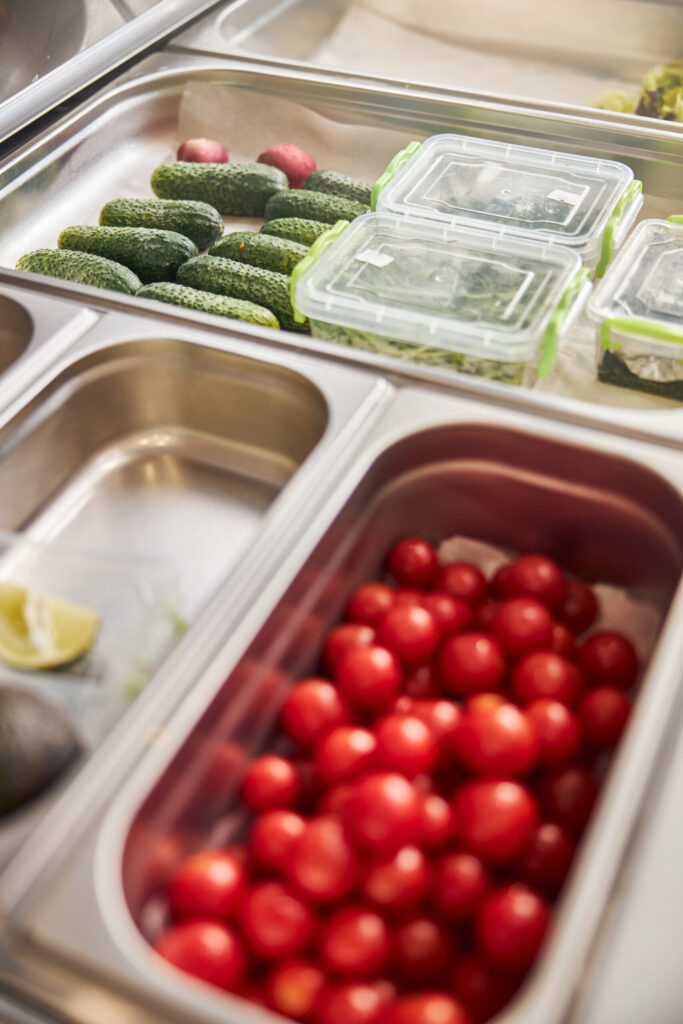
Cold air inside a prep table follows a specific route, and food safety depends on that route staying open. The evaporator coil sits in the cabinet or in a raised compartment behind the rail, and an evaporator fan pushes chilled air through a plenum that runs the length of the pan opening. Air rises around the stainless pans, cools the product by conduction through the metal, then falls back toward the return side of the coil. That loop only works if the pans sit fully seated in the rail and if the adapter bars and dividers stay in place. Every gap in the rail becomes a place where kitchen air enters and cold air spills out, which raises the load on the compressor and warms the pans nearest the opening. The lower cabinet uses a separate air path with its own shelving clearances, and blocking those vents with stacked cambros creates warm pockets that no thermometer on the door will show. A properly running system keeps the entire loop balanced so both zones stay under 41 degrees.
Temperature stratification explains why the top inch of product often reads warmer than the bottom of the pan. Cold air surrounds the sides of the pan, not the surface of the food, so the product closest to open air absorbs heat from the kitchen first. Line cooks who dig from the top and leave a shallow layer spread across the pan expose more surface area and speed that warming along. Deep pans loaded above the fill line push product above the rail, where the cold air blanket no longer reaches, and those top layers can climb past 41 degrees within an hour on a busy Saturday. This is a loading problem rather than an equipment problem, and it accounts for many failed inspections in kitchens where the refrigeration itself is running perfectly. Training staff to read product temperature with a calibrated probe in the food, not the air temperature on the digital controller, closes that gap. The controller reports what the cabinet is doing, while the probe reports what the customer will actually eat.
Ambient conditions in the kitchen change how hard the machine works. A prep table parked next to a fryer, a char broiler, or a pizza oven pulls hot air across its condenser and fights radiant heat on the rail at the same time. In Longview, summer kitchen temperatures often run well past the 75 degree rating used in NSF testing, which shrinks the safety margin the manufacturer built into the unit. Poor makeup air, a struggling rooftop unit, or blocked supply registers all compound the problem by letting kitchen heat build through the afternoon. Owners frequently blame the prep table when the real issue is a comfort cooling system that cannot keep the room in range. We look at both sides during a service visit because refrigeration performance and building air conditioning are connected. If the kitchen air handling needs attention, our commercial air conditioning service can address the root cause instead of chasing symptoms on the rail.

Pan Loading Habits That Keep Prep Table Refrigeration Food Safe
The single most common food safety failure we find has nothing to do with a broken part. Staff load warm product straight into the rail and expect the prep table to chill it, but a refrigerated rail is a holding device rather than a cooling device. Cooked chicken, freshly made tuna salad, and rinsed greens all carry heat or residual warmth, and dropping them into a pan raises the temperature of everything around them. Product needs to reach 41 degrees in a walk in cooler or a blast chiller before it ever touches the line. Following that sequence keeps the compressor from running continuously and keeps neighboring pans from drifting upward. Kitchens that treat the prep table as a cool down device create their own violations. Correct order of operations protects both the food and the equipment.
Fill lines exist for a reason, and ignoring them undoes the engineering of the entire unit. Every pan has a stamped or embossed line indicating the maximum product depth for safe holding, and product piled above that mark sits outside the cold air blanket. Overfilled pans also prevent lids from seating, which leaves the rail open to kitchen air during every lull. Using the correct pan size for volume matters just as much, since a sixth pan holding a small amount of product will hold temperature better than a third pan filled halfway with the same item. Rotating pans from the cabinet rather than topping off warm pans on the rail keeps every batch within a known holding window. Staff should also close the lids any time the line goes quiet, including during a mid afternoon slowdown. These habits cost nothing and prevent thousands of dollars in discarded product.
Overnight practices decide how the next morning starts. Prep tables are not designed to hold open pans through the night, and manufacturers instruct operators to cover the rail or move product into the cabinet at close. Leaving pans exposed lets the unit run against an open well for eight or ten hours, which frosts the evaporator, wastes energy, and often leaves product above 41 degrees at open. Night crews should verify that lids are seated, that the cabinet doors are shut, and that nothing is wedged against a gasket. A quick temperature check at close and again at open creates a record that shows the unit held through the night. That record protects the operator during an inspection and gives our technicians useful history when something starts to slip.
Why Prep Table Refrigeration Temperature Logs Prove Food Safe Holding
Temperature logs turn refrigeration performance into documentation an inspector can trust. Health departments across East Texas expect operators to demonstrate active managerial control, and a written log showing readings every four hours does exactly that. The log should record product temperature taken with a calibrated probe, the air temperature shown on the controller, the time, and the initials of the person checking. Any reading above 41 degrees triggers a corrective action, and the log should show what that action was. Discarding product, moving it to a working box, or applying time as a public health control all count as valid responses when documented properly. A blank log or a log filled out at the end of the week carries no weight at all.
Logs also serve as a diagnostic tool long before a total failure. A unit that used to read 36 degrees and now reads 40 degrees every afternoon is telling you something changed, even though it still technically passes. That drift usually points to a dirty condenser, a slipping refrigerant charge, or an evaporator fan losing speed. Catching the trend gives us time to schedule repair during a slow morning instead of responding to an emergency during Friday dinner service. Owners who review logs weekly catch these patterns without needing any technical background. The numbers do the work as long as somebody looks at them.
Thermometer calibration deserves the same attention as the logs themselves. A probe thermometer that reads three degrees low will pass product that is actually out of range, and the log will document a violation as compliance. Staff should calibrate probes in an ice water bath regularly, adjusting until the reading holds at 32 degrees. Built in controllers also drift over time, and we verify controller accuracy against a calibrated instrument during every service visit. Comparing the controller reading to a probe reading in the same space reveals sensor problems that would otherwise hide for months. Accurate instruments make every other food safety step meaningful.
Common Prep Table Refrigeration Problems That Put Food Safety at Risk
Most prep table failures announce themselves gradually. Temperatures creep upward, the compressor runs longer between cycles, and ice appears where it never used to form. Owners often adjust the thermostat colder to compensate, which masks the real problem and pushes the system harder until something quits entirely. The underlying causes are usually mechanical and predictable, and they follow the same short list across nearly every brand and model. Grease, dust, worn seals, and clogged drains account for the majority of service calls we run in commercial kitchens. Each one has a clear repair path when caught early. Waiting until the unit stops cooling turns a routine visit into an emergency with a cooler full of unusable product.
Dirty Condenser Coils and Prep Table Refrigeration Food Safety Risk
The condenser coil rejects heat from the refrigeration system into the kitchen, and it cannot do that job when it is coated in grease and flour dust. Commercial kitchens produce airborne oil that settles on every fin, and the sticky film traps dust until the coil face becomes a solid mat. Head pressure climbs as airflow drops, the compressor works harder for less cooling, and cabinet temperature rises even though the machine runs constantly. Energy consumption goes up at the same time, so the owner pays more to get less. In severe cases the compressor overheats and trips on its internal overload, shutting the unit down completely. That failure almost always happens during the hottest part of the day, which is also the worst possible time for a kitchen. Regular coil cleaning is the cheapest insurance available in commercial refrigeration.
Cleaning frequency depends on the kitchen environment rather than a generic calendar. A pizza shop with open flour handling may need coil cleaning every 60 days, while a sandwich shop with light cooking might stretch to a quarterly schedule. Location matters as much as frequency, since a prep table with a rear mounted condenser pushed tight against a wall never gets adequate airflow no matter how clean the fins are. Manufacturers specify minimum clearances, and respecting those clearances often solves a chronic temperature complaint by itself. Our technicians clean coils with the correct alkaline or acidic cleaner for the fin material, straighten bent fins, and verify that the condenser fan motor turns freely at full speed. Blowing the coil out with shop air alone leaves the grease behind and pushes debris deeper into the fin pack. Proper chemical cleaning restores heat transfer instead of just moving the dirt around.
Refrigerant charge problems often hide behind a dirty coil, and the two get confused frequently. A unit low on charge shows warm cabinet temperatures, long run times, and sometimes a frosted suction line, which looks similar to a condenser problem at a glance. Modern prep tables use refrigerants such as R290, R448A, or R449A, and each requires specific handling and charging procedures. R290 is a hydrocarbon with a small charge limit, and topping it off casually is neither legal nor safe. A leak in a hermetic system must be located and repaired rather than refilled, since the refrigerant will simply escape again and leave your product warm a second time. We use electronic leak detection and pressure testing to find the actual source before adding anything. Doing the diagnostic work correctly the first time keeps the repair permanent. If you also depend on a cold room for backup storage, our walk in cooler service covers the same careful approach for the rest of your refrigeration.
Worn Gaskets and Lids That Create Prep Table Refrigeration Food Safety Risk
Door and lid gaskets take constant abuse in a busy kitchen. Staff open cabinet doors with a hip or a forearm, carts bump the corners, and cleaning chemicals dry out the vinyl until it cracks. A gasket that no longer seals lets humid kitchen air pour into the cabinet, which drives up the temperature and loads the evaporator with moisture. The result is a coil that ices over, a compressor that never cycles off, and product sitting above 41 degrees near the door. Testing a gasket takes seconds with a dollar bill closed in the door, and any spot that slides out freely marks a leak. Replacing gaskets is inexpensive compared to the food loss and energy waste they cause. Most models use a snap in dart style gasket that a technician can change quickly during a scheduled visit.
Rail lids fail in similar ways and get replaced far less often. Hinged polymer lids warp from heat and from being flipped open against the wall hundreds of times a week, and once warped they no longer seal against the rail edge. Sliding covers jump their tracks and get set aside, then forgotten entirely. Every hour the rail sits uncovered during slow periods is an hour the pans absorb kitchen heat while the compressor fights back. Replacing damaged lids and training staff to use them restores the holding capacity the manufacturer designed into the unit. Adapter bars and false bottoms matter just as much, since missing hardware leaves openings straight into the cold air plenum. These parts are inexpensive and available for nearly every model on the market.
Door alignment problems often masquerade as gasket problems. Hinges wear, cam lift mechanisms lose their spring, and doors sag until they no longer pull square against the frame. A new gasket installed on a misaligned door will fail again within months because the sealing surface is not parallel. Drawer models add another layer, since drawer slides and roller assemblies wear and let the drawer front sit proud of the cabinet. Our technicians check hinge hardware, drawer tracks, and cabinet squareness before quoting gasket work so the repair actually holds. Fixing the mechanical alignment first is what separates a lasting repair from a return visit. That approach costs less over the life of the equipment even when the initial ticket is slightly higher.
Defrost and Drain Failures That Create Prep Table Refrigeration Food Safety Risk
Medium temperature prep tables typically use off cycle defrost, meaning the evaporator warms above freezing during the normal off period and melts any accumulated frost. That system works well as long as the unit actually cycles off, which requires a correct charge, a clean condenser, and reasonable door discipline. A unit running continuously never gets its off cycle, so frost builds until the coil becomes a block of ice and airflow stops completely. At that point the cabinet warms rapidly even though the compressor is running hard, which confuses staff who assume a running machine is a working machine. Visible ice on the evaporator is always a signal to call for service rather than a normal condition. Chipping the ice off with a knife damages the coil fins and often punctures a tube, turning a service call into a major repair.
Condensate drains cause a different set of problems that end in the same place. Melted frost has to travel through a drain pan, down a drain line, and into either a floor drain or an evaporator pan on the condensing unit. Food debris, grease, and biofilm clog those lines steadily, and a blocked drain sends water pooling into the cabinet floor. Standing water under product creates a direct contamination risk and gives an inspector an easy violation to write. Water that freezes in the drain pan blocks flow entirely and can back up into the evaporator compartment. Flushing drain lines and cleaning drain pans belongs on every maintenance visit, not on an emergency call. Clean drains also cut down on odors that transfer into open pans of food.
Control failures round out the list and are worth understanding. Digital controllers rely on a thermistor probe placed in the return air stream, and a probe that comes loose or gets coated in debris reports the wrong temperature to the board. The controller then either short cycles the compressor or lets the cabinet warm well past setpoint while displaying a comfortable number on the screen. Thermostat and controller settings also get adjusted by staff who think colder is always better, which frosts coils and wastes energy without improving food safety. Setting the unit correctly and locking the controller prevents that cycle. During service we verify probe placement, controller calibration, and setpoint against the manufacturer specification so the display reflects reality.
Why You Need Professional Prep Table Refrigeration Service in Longview
Commercial refrigeration failures do not wait for convenient hours, and the cost of a single warm night reaches far beyond the repair bill. Discarded inventory, a closed line, and a damaged reputation with regular customers all follow a prep table that quit at the wrong moment. Regular professional service prevents most of those failures by catching wear before it becomes a breakdown. R.C.s A/C Reliable Climate works on prep tables, walk in boxes, and comfort cooling for restaurants throughout Longview and the surrounding communities. We hold Texas HVAC License number TACLA129043C, we carry full insurance, and we back our work with a 10 year parts warranty and a 1 year labor warranty. Keeping your kitchen cold is the whole job, and we treat it that way.
Scheduled Prep Table Refrigeration Service Protects Your Longview Kitchen
Planned maintenance costs a fraction of emergency repair and almost always pays for itself in energy savings alone. A clean condenser, correct charge, sealed gaskets, and clear drains let the compressor cycle normally instead of running around the clock. Shorter run times mean lower electric bills, less compressor wear, and a longer service life for equipment that is expensive to replace. We schedule visits during prep hours or after close so your line never stops for our work. Documentation from each visit gives you a paper trail showing an inspector that the equipment is maintained by a licensed contractor.
Every maintenance visit follows the same thorough checklist regardless of brand. We clean condenser coils chemically, verify condenser and evaporator fan operation, check superheat and subcooling, inspect the electrical connections, test gaskets, flush drains, and calibrate the controller against a reference thermometer. Anything wearing out gets flagged with a photo and a clear explanation so you can plan the repair on your schedule. We do not recommend parts you do not need, and we tell you plainly when a component still has life left. Honest recommendations are how we keep restaurant accounts for years instead of months.
Multi unit kitchens benefit even more from a coordinated plan. Most restaurants run a prep table alongside a reach in, a walk in cooler, and a freezer, and all of those systems share the same kitchen conditions and the same maintenance risks. Servicing them together on one visit reduces your total cost and gives us a complete picture of how the kitchen performs. We track the history of each unit so you know which piece is approaching replacement and can budget for it. Need reliable cold storage backing up your line? Take a look at our walk in freezer service to cover the rest of your refrigeration.
Emergency Prep Table Refrigeration Repair Saves Longview Food Inventory
When a prep table fails during service, response time decides how much product survives. We offer 24 hour emergency service because refrigeration problems do not respect business hours, and a Saturday night failure cannot wait until Monday morning. Our trucks carry common gaskets, fan motors, controllers, and refrigerant so many repairs finish on the first visit. Getting the unit back in range quickly limits how much food crosses out of the safe holding window. Fast action often saves inventory that would otherwise go straight into the dumpster.
We also help you make the right call about product while we work. Food held above 41 degrees for less than four hours can often be cooled quickly and saved, while anything past that window has to be discarded under Texas rules. Knowing when the unit failed makes that decision much easier, which is another reason temperature logs matter. Our technicians will tell you what the equipment temperatures indicate so you can make an informed choice. We will not guess about food safety, and we will not pressure you into a decision that puts your customers at risk.
Financing is available for larger repairs and for replacement when a unit reaches the end of its life. Compressor failure on an older prep table sometimes costs more than the remaining value of the cabinet, and we lay out both options with real numbers. Free estimates on new installations let you compare honestly without any obligation. Restaurants operate on thin margins, and we respect that when we write a quote. Our goal is to keep your kitchen running profitably, not to sell you the largest ticket we can.
Why Choose R.C.s A/C Reliable Climate for Prep Table Refrigeration Service
We are locally owned and operated right here in Longview at 3 Lewis Drive, and our technicians live in the same communities we serve. That means shorter drive times to Kilgore, Marshall, Hallsville, White Oak, Gilmer, Gladewater, Liberty City, and Lakeport when your equipment needs attention. Local ownership also means accountability, since our reputation travels through the same restaurant community you belong to. We built this business on 5 star service and we work to earn that rating on every call. You will talk to people who know your kitchen rather than a call center three states away.
Our approach centers on honest recommendations without unnecessary upsells. A dirty coil gets cleaned, a bad gasket gets replaced, and a healthy compressor gets left alone. We explain what we found in plain language, show you the readings, and let you decide how to proceed. Licensed and insured work under Texas HVAC License number TACLA129043C means the repair meets code and your liability is covered. Warranty coverage of 10 years on parts and 1 year on labor stands behind everything we install.
Ready to get your prep table running the way it should? Call us at (903) 316-6855, email info@iwantclimate.com, or click here for our prep table refrigeration service to schedule a visit. We will assess the unit, document its performance, and give you a clear plan for keeping ingredients food safe. Restaurants across East Texas trust us with the equipment their business depends on every day. Let us do the same for your kitchen.